This video gives a good overview of Magellan.
And this site has some wonderful questions, writing prompts, and even crafts to provide a cohesive lesson this week--including making porcelain (? that's what it says) and spiced tea, sea rations, and an hourglass out of two-liter bottles. There are three pages of it! So glad someone else comes up with stuff like that for us...
If you're working on the memory work, try it to the tune of "Did You Ever See a Lassie?" Like this:
In 1522
Ferdinand Magellan
a Portugese explorer
dis-COV-ered a ROUTE
to SAIL around the WOR-ld
to PROVE it was ROU-nd!
In 1522
Magellan did these things!
Monday, March 14, 2011

Sunday, March 13, 2011
Japanese Earthquake: Before and After Pictures
This site has amazing before and after google images of Japan. If you move your mouse over the image it changes the picture.
HT: A Bit of This & A Bit of That (who lives in Japan). She's organizing a fund-raiser auction, too.
HT: A Bit of This & A Bit of That (who lives in Japan). She's organizing a fund-raiser auction, too.
Lunchtime Laughter
When I remember, I like to add a joke to my first grader's lunch box. He loves telling it to his friends (as if they need an ice breaker for the dinner hour!)
Usually I just google "riddles" or "simple jokes" the night before and find one that's age appropriate.
Tomorrow's jokes:
Q: I am lighter than a feather, yet no man can hold me for very long. What am I?
A: Breath
Q: Feed me and I live, give me something to drink and I'll die. What am I?
A: Fire
One of my favorites from the past:
Q: What does a termite eat for breakfast?
A: Oak-meal
-Julie
Usually I just google "riddles" or "simple jokes" the night before and find one that's age appropriate.
Tomorrow's jokes:
Q: I am lighter than a feather, yet no man can hold me for very long. What am I?
A: Breath
Q: Feed me and I live, give me something to drink and I'll die. What am I?
A: Fire
One of my favorites from the past:
Q: What does a termite eat for breakfast?
A: Oak-meal
-Julie
Wednesday, March 9, 2011
Orion in 3-D
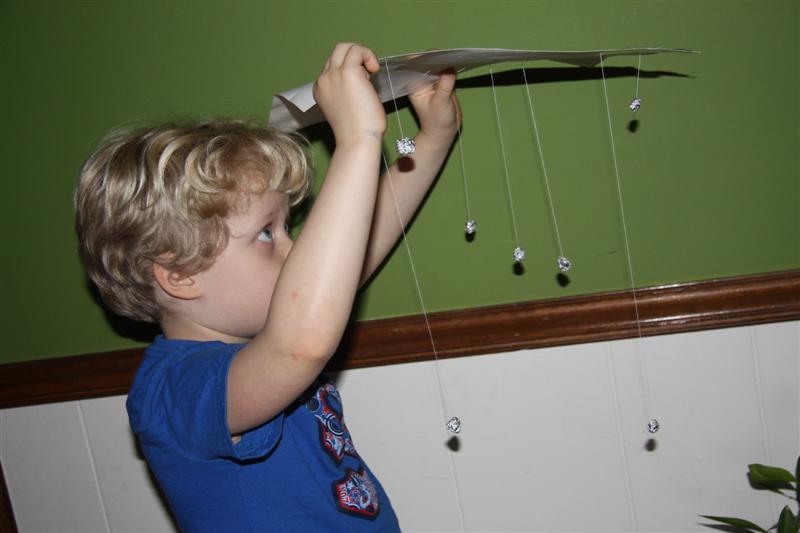
We completed the three-dimensional Orion project from PBS today, and it was a great exercise. We used foil instead of cotton balls (because that's what I had, and it looked like stars), and simply squeezed the string into the foil balls. It was good practice for measurement, reading fractions, and spatial understanding, as well as learning some stars' names, like Betelgeuse.
Can you see Orion?
Monday, March 7, 2011
Stars and constellations

National Geographic Kids has some striking photos from NASA of stars and constellations, as well as of the planets we talked about last week. Scroll down on the page for photos of the moon and sun as well.
Here's a printable sheet of constellations and their patterns! This site is a good place for excited stargazers to start.
Here's a preview of a PBS film on the wonders of stargazing, entitled "Seeing in the Dark." The telescopes are cool, too. The film's site has some beautiful photos, how-to videos on stargazing, and your sky tonight feature. They have a great list of activities for teachers, including telling time by the Big Dipper, showing distances in the solar system with rolls of toilet paper, and how escaping slaves learned to use the Big Dipper to escape North! I think we're going to make Uncle Al's starwheel so that we can look for the right constellations at the right time of year.
On this site, a NASA astronomer answers some of kids' common questions about stars--what they are, what they're made of, how far away they are...you get the idea.
For younger elementary school students, this experiment explains an elementary version of why stars twinkle.
Here's a project to make constellation placemats from black construction paper--and one to make window constellations.
And here's another (slightly overwhelming) list of links on constellations and stars.

Here's a printable sheet of constellations and their patterns! This site is a good place for excited stargazers to start.

Here's a preview of a PBS film on the wonders of stargazing, entitled "Seeing in the Dark." The telescopes are cool, too. The film's site has some beautiful photos, how-to videos on stargazing, and your sky tonight feature. They have a great list of activities for teachers, including telling time by the Big Dipper, showing distances in the solar system with rolls of toilet paper, and how escaping slaves learned to use the Big Dipper to escape North! I think we're going to make Uncle Al's starwheel so that we can look for the right constellations at the right time of year.
On this site, a NASA astronomer answers some of kids' common questions about stars--what they are, what they're made of, how far away they are...you get the idea.
For younger elementary school students, this experiment explains an elementary version of why stars twinkle.
Here's a project to make constellation placemats from black construction paper--and one to make window constellations.
And here's another (slightly overwhelming) list of links on constellations and stars.
Cortez for kids
The History Channel was generous with us on this week's topic. Here, we've got Montezuma and Cortez, plus Mexico: God, Gold, and Glory: Cortez Part 1 (the Spaniards' arrival), Part 2 (fall of Montezuma), and Part 3 (final battles with the Aztecs). I have not previewed all of these, but I would expect them to be around a "TV-PG" rating.
Thursday, March 3, 2011
Sistine Chapel panorama
Another great link from Anne Coletti:
This is a visit to the Sistine Chapel. Give it time to load, then you can use your mouse to look around. Have your sound turned on.
Thanks, Anne!
This is a visit to the Sistine Chapel. Give it time to load, then you can use your mouse to look around. Have your sound turned on.
Thanks, Anne!
More solar system activities for kids!
You can watch The Magic School Bus: Out of This World and The Magic School Bus: Lost in Space, then utilize this printable and lesson idea (scale it to a homeschooling level) from Scholastic. Here's their "Space Chase" game, as well, which gives kids clues for guessing a planet. There are also two clever poems for kids about space on this page.
Here's another huge list of space links for kids, too, and some activities from enchantedlearning.com. NASA also has a few lesson plans categorized by age.
These lesson plans are for those of you who really want to do something big: Using items like pumpkins, softballs, and poppy seeds to get an idea of the scale of our galaxy.
This site also had some wonderful application ideas from teachers on the solar system, including making marks on your playground (yard) outside to demonstrate distance between planets.
Here's another huge list of space links for kids, too, and some activities from enchantedlearning.com. NASA also has a few lesson plans categorized by age.
These lesson plans are for those of you who really want to do something big: Using items like pumpkins, softballs, and poppy seeds to get an idea of the scale of our galaxy.
This site also had some wonderful application ideas from teachers on the solar system, including making marks on your playground (yard) outside to demonstrate distance between planets.
Tuesday, March 1, 2011
Solar System links
This page had a lot of great links to learn about the solar system, as did this one (not all of the links are still active). Through this, I found NASA's Space Place, with some fun games, like the Solar System Switcharoo that teaches about different moons, etc. found in our solar system. I also like "Play Year of the Solar System."
Online jigsaw puzzles: US Capitals and more
For learning geography, check out this page of drag and drop puzzles, including quizzes for the states and their capitals. You can even choose your level, as you can on these online jigsaw puzzles of the states; level one has them by region, like our memory work.
Subscribe to:
Posts (Atom)